You just finished a restaurant menu shoot. Maybe 30 dishes, each plated fresh, styled within a window of minutes before the garnish wilts, the sauce skins over, and the ice cream becomes soup. Your card has 400-800 frames, and somewhere in there are the hero shots that will make diners hungry.
Food photography has a unique constraint: time kills your subject. Unlike portrait sessions where you can reshoot a pose, a melting dessert or a wilting salad doesn't get a second chance. Your culling needs to identify the frames captured in that narrow peak-freshness window while the styling was intact.
Here's how to cull food photography efficiently without missing the money shots.
Why food photography culling is different
Food photography has unique characteristics that change the culling equation:
Freshness degrades in real-time. Every dish has a "hero window" - the minutes (sometimes seconds) when it looks its absolute best. Lettuce crisps, sauces glisten, steam rises, ice cream holds its shape. Your keeper is almost always in this window. Frames shot after peak freshness might be technically identical but visually inferior.
Styling integrity matters more than expression. In portraits, you're judging expression and connection. In food, you're judging whether the garnish is placed correctly, the sauce drizzle looks intentional, the plate is clean, and everything is where the food stylist put it.
You shot variations of variations. For each dish, you probably shot multiple angles, multiple compositions, and multiple styling adjustments. That's 15-30 frames per dish, and the differences between them are often subtle - a slightly different garnish position, a fractionally better sauce pool, a marginally cleaner plate edge.
Color and texture are everything. Food photography lives or dies on appetizing color and visible texture. A frame where the lighting flattens the texture or shifts the color temperature toward unappetizing tones is a reject, even if composition is identical to a keeper.
The shot list defines success. Most food shoots start with a brief: hero shot, overhead, detail, lifestyle context. Your cull isn't "find the best images" - it's "find the best execution of each required shot type for each dish."
Step 1: organize by dish, not by timestamp
Before culling, group your images by the dish being photographed. A menu shoot might cover 30 dishes, and each dish is its own culling unit.
Why grouping matters: The question isn't "what are the best 60 images from this shoot?" It's "what are the best 2-3 images of the carbonara, then the risotto, then the tiramisu?" Each dish needs representation regardless of how many total frames you shot.
Time-based scene detection helps: If you paused between dishes while the kitchen plated the next one, those gaps create natural scene boundaries. A 3-minute pause while waiting for the soufflé separates it from the pasta you just finished.
Shot type sub-grouping: Within each dish, you likely shot multiple angles:
- Hero/front (the money shot)
- Overhead/flat lay
- 45-degree
- Detail/texture close-ups
- Lifestyle/context (hands, table setting, restaurant environment)
Mentally sub-group these as you cull - you're not just finding the best image of the dish, you're finding the best execution of each angle the client needs.
Step 2: the freshness window identification
Your first culling pass should identify the peak freshness window for each dish:
Signs of peak freshness:
- Sauces glistening, not skinned over
- Garnishes vibrant and positioned correctly
- Steam visible (if applicable - and if you want it)
- Ice cream/frozen elements holding shape
- Greens crisp, not wilted
- Proteins showing just-cooked juiciness
- Condensation on cold drinks looking fresh, not drippy
Signs of freshness decay (immediate rejects):
- Sauce starting to congeal or separate
- Garnish wilting, browning, or sliding
- Ice cream melting beyond the "appetizing drip" stage
- Grease pooling where it wasn't intended
- Steam dissipated on a dish meant to look hot
- Lettuce going limp, cheese going rubbery
- Condensation turned to puddles
The timeline reality: Most dishes have a 5-15 minute hero window. Your first frames (test shots, lighting adjustments) might precede peak styling. Your later frames might catch decay. The sweet spot is usually in the middle of each dish's sequence.
Reject everything outside the window first. This clears 30-50% of frames before you even evaluate composition.
Step 3: technical quality pass
With freshness-decayed frames eliminated, do a technical pass:
Immediate rejects:
- Missed focus (critical area soft - usually the hero element of the dish)
- Motion blur from camera shake or moving elements
- Exposure issues that lose critical detail (blown highlights on white plates, crushed shadows hiding food texture)
- Color contamination from reflections or ambient light mixing with strobes
- Visible crew/equipment reflections in shiny surfaces
- Dust, crumbs, or drips in wrong places
Food-specific focus points: Unlike portraits where eyes are the focus target, food has dish-specific focus priorities:
- Burgers/sandwiches: Cross-section layers visible and sharp
- Pasta: Noodle texture, sauce coating
- Steaks/proteins: Surface sear, internal color if cut
- Soups: Surface garnish, steam suggestion
- Desserts: Hero element (the chocolate drip, the berry, the caramel)
- Drinks: Liquid clarity, garnish, condensation
Check focus at 100% on the hero element, not just "somewhere on the dish."
Step 4: styling integrity check
Now you're comparing frames where freshness and technical quality are both acceptable. The differentiator is styling:
What to evaluate:
Garnish position: Is the basil leaf where the stylist placed it? Did the microgreens shift? Is the lemon wedge at the intended angle?
Sauce placement: Does the drizzle look intentional and appetizing? No unplanned drips? Pool shapes flattering?
Plate cleanliness: No sauce smears on the rim? No fingerprints? No crumbs outside the food area?
Prop arrangement: Cutlery, napkins, ingredients in background positioned correctly? Nothing shifted between frames?
Hero element visibility: Is the star of the dish prominently featured? Nothing obscuring it?
Comparison is essential here: Two frames might look identical at first glance. Side-by-side comparison reveals that in Frame A the sauce drizzle looks more intentional, or in Frame B the garnish is positioned 2mm better. These tiny differences matter in commercial food work.
Step 5: the appetite test
The final filter for food photography is subjective but critical: does this image make you hungry?
The visceral response test: Before analyzing composition or technicalities, look at each candidate and notice your gut reaction. Does it trigger appetite? Does the food look like something you'd want to eat right now?
What creates appetite appeal:
- Visible texture (crispy, creamy, juicy)
- Appetizing color temperature (warm tones for cooked food, cool for fresh)
- Glistening surfaces suggesting freshness and flavor
- Steam or heat suggestion (warmth = fresh from kitchen)
- Portion that looks satisfying but not overwhelming
- Context that suggests enjoyment (lifestyle shots)
What kills appetite:
- Flat lighting that removes texture
- Color casts that make food look artificial or old
- Overcrowded compositions that feel chaotic
- Portions that look either stingy or excessive
- Styling that looks too perfect/artificial
- Backgrounds that distract from the food
Your client is selling food. The image needs to make people want to eat it. Technical excellence means nothing if the dish doesn't look delicious.
Handling different food photography contexts
Restaurant menu shoots:
- Each dish needs at least one hero shot
- Consistency across the menu matters (similar lighting mood, styling approach)
- Efficiency is critical - you might shoot 30 dishes in one day
- Coordinate with kitchen on plating order (shoot dishes with longest freshness windows last)
Editorial/magazine work:
- More creative freedom, fewer dishes, higher production value per shot
- Lifestyle context matters more than menu coverage
- May need multiple distinct looks from same dish
- Culling for variety and narrative, not just technical quality
Packaging/product shots:
- Consistency is paramount - every box/bag must look identical
- Focus on the product, minimal styling variance
- Color accuracy critical for brand compliance
- Often need multiple identical shots for compositing
Social media/content:
- Vertical crops matter more (Instagram, TikTok)
- Punchy, colorful, stop-the-scroll appeal
- May want more casual/approachable styling
- Behind-the-scenes and process shots have value
Know which context you're culling for - it changes what "best" means.
Delivery benchmarks
Illustrative planning ranges, not industry benchmarks.
| Shoot Type | Typical Frames/Dish | Typical Delivery/Dish | Total Cull Time |
|---|---|---|---|
| Menu shoot (30 dishes) | 15-25 | 2-4 finals | 60-90 min |
| Editorial (5-8 dishes) | 30-50 | 5-10 finals | 45-60 min |
| Packaging (10 products) | 10-20 | 1-3 finals | 30-45 min |
| Social content | 20-40 per setup | 3-8 finals | 20-30 min |
Per-dish culling time:
- 15-25 frames → 3-5 minutes (including freshness and styling evaluation)
- Complex dish with multiple angles → 5-8 minutes
Gallery composition for menu work:
- Hero shots: 50-60% (the main selling images)
- Alternate angles: 20-30% (overhead, detail)
- Lifestyle/context: 10-20% (restaurant atmosphere, hands, table setting)
If you're taking significantly longer than these benchmarks, you're probably over-comparing similar frames. Trust your appetite test - if both frames make you hungry, pick one and move on.
Working with food stylists and clients
Food stylist collaboration:
- The stylist knows which frames have the best styling - check in during the shoot if possible
- Flag any frames where you noticed styling issues in real-time
- Stylist adjustments mid-dish create natural groupings ("before tweak" vs "after tweak")
Client/art director input:
- If the client was on set, their real-time reactions matter - frames they responded to positively are likely keepers
- Some clients want to see multiple options; others want you to make the call
- Clarify before delivery: "I'll send 3 options per dish" vs "I'll send my top pick per dish"
Feedback integration:
- Track which dishes/angles get selected for final use
- Client preferences inform future culling decisions
- Some clients consistently prefer overhead; others prefer hero angles - learn their taste
Common food photography culling mistakes
Keeping frames from outside the freshness window. That first test shot might have perfect composition, but if the garnish was still being placed, it's not a keeper. Freshness > composition.
Ignoring styling drift. Over 30 frames, garnishes shift, sauces settle, props move. Later frames aren't automatically better - check that styling is still intact.
Evaluating at thumbnail size. Food photography rewards texture and detail. What looks fine at fit-to-screen might reveal soft focus on the hero element, sauce separation, or condensation issues at 100%.
Over-delivering options. If the brief calls for one hero shot per dish, delivering five "options" looks indecisive. Make the call - that's what they're paying you for.
Forgetting the shot list. Getting excited about a beautiful overhead and forgetting you never delivered a usable hero angle. Check coverage before declaring a dish complete.
Color inconsistency across the set. A menu needs visual coherence. If one dish looks warm and another looks cool due to ambient light shifts, the set feels disjointed. Catch this in culling, not after export.
Speed techniques for food culling
Workflow suggestion: test keyboard and mouse input on your own setup.
Keyboard workflow: Arrow keys to navigate, P to pick, X to reject. Mouse usage kills speed on a 600-frame menu shoot.
Freshness-first filtering: Reject decay frames immediately - don't waste time evaluating composition on a frame where the ice cream is soup.
Process by dish, not by shoot: Complete one dish before moving to the next. Context-switching between the burger and the pasta slows your eye.
The 30-second rule for ties: If you've been comparing two frames for more than 30 seconds, they're both good enough. Pick one. The client won't know there was a choice.
Flag hero candidates immediately: As you scan each dish sequence, flag anything that makes you hungry. These are your comparison candidates. Then compare only the flagged frames.
Trust the stylist's moment: If you remember the food stylist stepping back and saying "that's it" - find that frame. Their expertise often identifies peak styling better than frame-by-frame comparison.
The bottom line
Food photography culling is a race against decay. Your subject is dying from the moment it's plated, and your job is to identify the frames captured in that narrow window when styling, freshness, and technical execution all aligned.
Organize by dish. Filter for freshness first. Evaluate styling integrity. Apply the appetite test. Check coverage against the shot list.
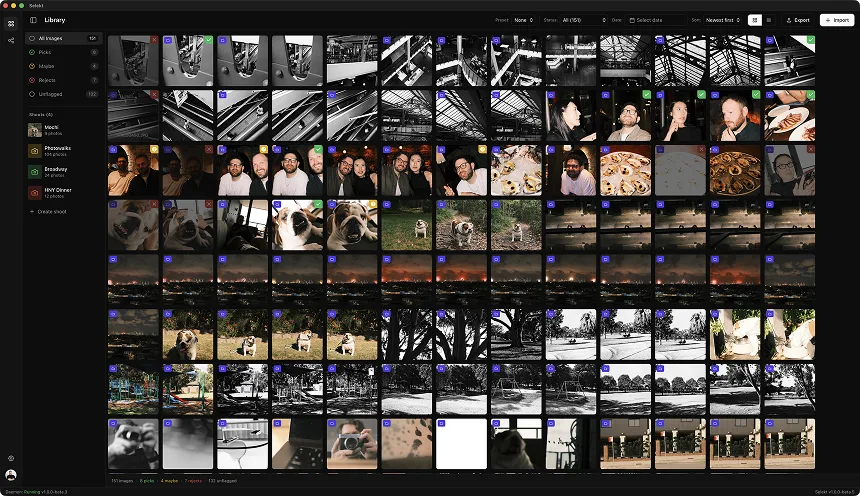
Selekt handles the organizational structure food photographers need. Scene grouping clusters your dishes. Comparison view catches the subtle styling differences between similar frames. Keyboard-driven workflow keeps you moving through a 30-dish menu shoot without drowning in thumbnails.
The garnish is wilting in your imagination. Start culling.