Direct answer: deliver enough finished photographs to cover the brief without padding the gallery with repeats. There is no universal industry number. A useful planning range is often 40-80 finished images per hour for a wedding, 15-40 for a one-hour portrait session, or 25-60 per hour for a general event, but those are starting assumptions, not standards. A detailed cultural ceremony, a conference with many sponsors, and a tightly art-directed portrait session need different answers.
Set the number before the shoot from the client's uses, required people and moments, coverage length, and the amount of variation you can create. Promise a minimum or an approximate range in the contract, then deliver every strong image needed to fulfil it.
Use a coverage formula, then check the story
Start with a simple estimate:
planned delivery = coverage hours × target images per hour + required variations
Example: an eight-hour wedding at a planning rate of 60 images per hour gives 480. Add 40 required family-group variations and detail photographs, and the working estimate becomes about 520. This is planning arithmetic, not proof that 520 is the correct wedding total.
Then test the estimate against the brief:
- Does every promised moment, person, product, or room appear?
- Are there useful wide, medium, and close views where the client needs them?
- Have near-duplicates been removed unless they show a distinct expression or action?
- Can every delivered frame meet the editing and quality standard?
If the coverage audit exposes gaps, the solution is usually better shot planning rather than a looser cull.
Illustrative planning ranges by shoot type
These ranges are examples for quoting and capacity planning. Adjust them to your style, market, brief, and contract.
| Shoot type | Illustrative finished range | What changes it |
|---|---|---|
| 8-hour wedding | 320-640 | Ceremony traditions, guest count, second photographer, reception programme |
| 2-hour elopement | 80-180 | Locations, portraits, guests, ceremony detail |
| 1-hour portrait session | 15-40 | Outfits, locations, individuals, licensed uses |
| 20-minute mini session | 5-15 | Package design and number of people |
| 4-hour corporate event | 100-240 | Speakers, sponsors, attendee coverage, same-day press needs |
| Headshot station | 2-5 per person | Expression and crop variations promised |
| Product shoot | Shot-list driven | Angles, colourways, crops, retouching scope |
| Real-estate shoot | Property/brief driven | Rooms, exterior views, amenities, local listing rules |
A second photographer increases coverage opportunities, but should not automatically double delivery. Commercial work is usually clearer when priced and delivered by approved shot list rather than by hours.
Work backwards from the client’s use
Wedding: map the day into sections (preparation, ceremony, portraits, reception) and assign a flexible target to each. Protect required family groups and cultural moments before trimming repeated candids.
Portrait or family session: count distinct looks, groupings, and locations. If the package promises three outfits and five finished images from each, the minimum is already 15 before useful alternatives.
Event: build a coverage checklist for speakers, sponsors, signage, audience, networking, awards, and venue. A technically strong gallery can still fail if a named stakeholder is absent.
Commercial or product: let the approved shot list control the count. Record products, angles, aspect ratios, backgrounds, and usage variants as separate deliverables. “More” can create extra retouching and licensing ambiguity.
Editorial or sports: the publication, deadline, story angle, and transmission workflow matter more than a generic keep percentage. Ask the assigning editor what they need.
Do not calculate delivery from frames shot
A keep percentage is useful for estimating storage or post-production load, but it is weak client-facing logic. Burst rate, subject movement, bracketing, and shooting style can change the capture count without changing what the client needs. Two photographers can cover the same job well while exposing very different numbers of frames.
Use the captured total only as an internal check. If a 2,400-frame event is planned at 180 finished images, the implied keep rate is 7.5%. That helps estimate review work; it does not make 7.5% a quality rule.
During the cull, separate technical screening from editorial selection. First flag focus, blur, and exposure problems for review. Then compare similar frames for expression, gesture, composition, and brief coverage. Automated signals can accelerate the first pass, but the photographer still owns the creative and contractual decision.
Put a clear quantity promise in the contract
Use language your workflow can reliably meet. For example:
Your gallery will include at least 450 individually edited photographs. Based on the agreed eight-hour schedule, the expected range is approximately 450-600. The final count depends on the events and coverage on the day. The curated gallery excludes test frames, accidental captures, duplicates, and unfinished files. Delivery is due within four weeks.
The useful terms are:
- a minimum you can meet even when the day runs quietly;
- an estimated range rather than an exact ceiling;
- what “finished” means, including retouching limits;
- whether RAW files or proofs are included;
- delivery timing and gallery availability;
- extra-image pricing if the client can purchase more.
Have a lawyer in your jurisdiction review your standard agreement. Contract language and consumer rules vary by location.
A repeatable delivery workflow
- Before the shoot: list client uses, mandatory coverage, variations, and channels or crops. Set the minimum and estimate.
- After import: back up the originals and group images by scene, setup, person, or shot-list item.
- Technical pass: identify frames that need close inspection for focus, motion blur, or unusable exposure. Avoid deleting solely because software assigns a low score.
- Editorial pass: choose the best expression, gesture, timing, and composition from each group.
- Coverage audit: check every required moment, person, product, and format against the brief.
- Consistency pass: remove accidental repeats and confirm colour, crop, retouching, filenames, and export settings.
- Contract check: confirm the final total meets the promise before delivery.
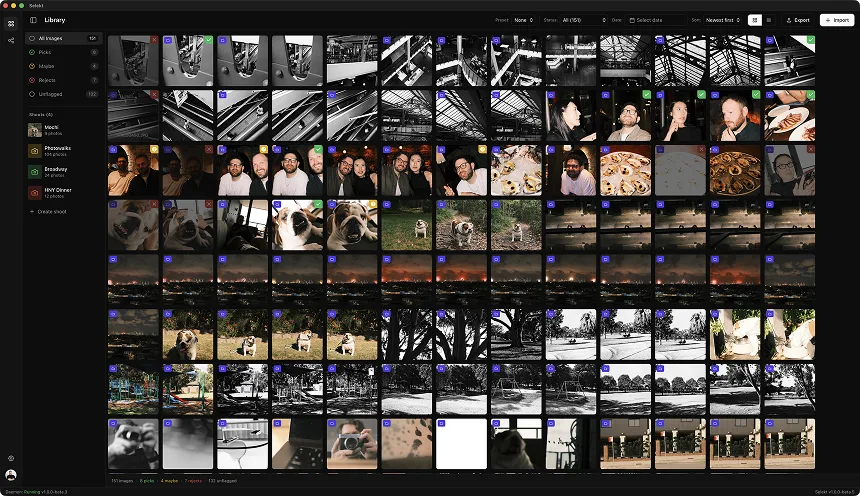
Selekt can support the middle of this workflow on Mac and Windows: manual culling is unlimited on the free plan, on-device analysis surfaces focus, exposure, and blur signals and groups related frames, and optional cloud AI adds face checks and tags, covering 100 photos a month on Free and everyday shooting on Pro. Those aids do not know the client brief; keep the coverage checklist beside the cull.