Photo culling on your phone: a practical guide for iPhone and Android
Can you cull photos on your phone between shoots? Yes, and it might change your workflow. Here's how mobile culling works on iPhone and Android, what apps to use, and when it actually makes sense.
You just finished a 4-hour portrait session. It's 6pm. You have dinner plans, then another shoot tomorrow morning. Somewhere between now and delivering finals, you need to cull 1,800 images. The laptop is at home. The card is in your bag. And you're sitting on a train with 40 minutes to kill.
This is where mobile culling starts to make sense. Not as a replacement for your desktop workflow, but as a way to reclaim dead time. The commute, the wait between shoots, the couch at 9pm when you're too tired to sit at a desk but not too tired to swipe through photos.
Most photographers haven't considered culling on their phone because until recently, there wasn't a good way to do it. That's changed.
Why cull on your phone?
The honest answer: convenience and momentum.
Culling on a desktop is better in almost every technical way. Bigger screen, more precise colour, keyboard shortcuts, faster processing. Nobody's arguing your iPhone 16 Pro is a better culling station than your calibrated 27-inch display.
But the best culling workflow is the one that actually happens. If your pattern is "I'll cull tonight" followed by three nights of not culling, then a phone-based first pass on the train home might get you further than a theoretically perfect desktop session that keeps getting postponed.
There's also a cognitive advantage. A first pass on your phone strips away perfectionism. The screen is small. You can't pixel-peep. You're making gut decisions: yes, no, maybe. That's actually what a first cull should be. Save the detailed comparison and technical evaluation for the desktop. Use your phone for the instinctive editorial pass.
And there's the freshness factor. Culling immediately after a shoot, while the moments are still vivid in your memory, produces different picks than culling three days later when the shoot has blurred into a vague recollection. You remember which smile was genuine. You remember the moment the wind caught the veil. That context fades fast.
Getting photos onto your phone
This is the practical hurdle. Your photos are on a memory card or your camera, and you need them accessible on your phone.
Camera WiFi transfer. Most modern cameras (Sony, Canon, Fujifilm, Nikon) have companion apps that transfer images over WiFi. The catch: transferring full RAW files is painfully slow. Most camera apps send compressed JPEGs by default, which is actually fine for culling purposes. You don't need full resolution to decide if the expression is right.
Cloud sync from your computer. If your desktop imports the images and you use iCloud, Google Photos, Dropbox, or similar, the previews will eventually sync to your phone. The lag depends on your upload speed and library size. This works but isn't instant.
USB-C card readers. Both iPhone 15+ and most Android phones support USB-C card readers. Plug in your SD card, open Files (iOS) or your file manager (Android), and your images are right there. This is the fastest method for getting full-resolution files onto a phone.
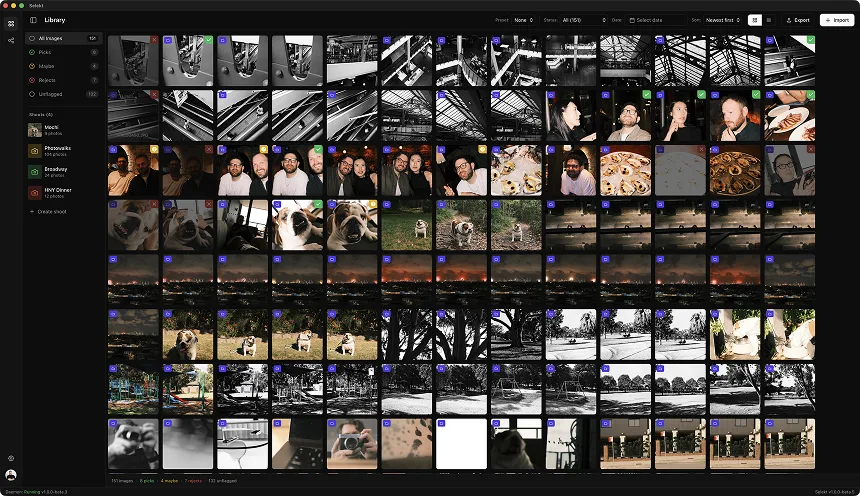
Dedicated sync. Some culling tools sync your shoot from desktop to phone automatically. You import on your Mac or PC, and the images appear on your phone ready to cull. This is what Selekt's mobile apps (coming soon) are designed to do: import a shoot on desktop, and it'll be available on iOS and Android for mobile culling, with your picks syncing back to the desktop when you're done.
The sync approach is the least friction. No cables, no manual transfers, no waiting for cloud uploads. You import the shoot at home, leave for dinner, and start culling on your phone whenever you're ready.
What makes a good mobile culling app?
Not every photo app is built for culling. Scrolling through your camera roll in Apple Photos isn't culling, it's browsing. A real culling workflow needs specific things.
Swipe or tap to rate. The core interaction needs to be fast and one-handed. Swipe right to keep, swipe left to reject, or simple tap targets for yes/no/maybe. If you have to open a menu or long-press to flag an image, it's too slow.
Auto-advance. After you make a decision, the next image should appear immediately. No scrolling, no tapping "next." The rhythm should be: look, decide, swipe, look, decide, swipe. Anything that breaks that rhythm kills your speed.
Decent preview quality. You don't need pixel-level zoom on a phone (your eyes can't resolve it on a 6-inch screen anyway), but you need enough resolution to judge focus, expression, and composition. Embedded JPEG previews from RAW files work well here.
Sync back to desktop. This is the make-or-break feature. If your mobile picks don't sync back to your desktop workflow, you're doing the work twice. Whatever system you use, your phone decisions need to appear on your desktop — as star ratings, colour labels, flags, or whatever your editing app understands.
Scene or group view. Just like desktop culling, seeing your images grouped by moment or setup is far more effective than a flat scroll. On a small screen, this matters even more because scrolling through thousands of thumbnails on a phone is genuinely painful.
iPhone options
Apple Photos. Free, already on your phone, but terrible for serious culling. No auto-advance, no quick flag system, no scene grouping. You can favourite images with a heart tap, but there's no reject mechanism and no way to sync those favourites into Lightroom or Capture One. Fine for personal snapshots, not for professional culling.
Lightroom Mobile. Free tier available, full features with Creative Cloud subscription ($10-55/month depending on plan). Syncs with Lightroom Classic on desktop. You can flag and rate images, and those ratings sync back. The downsides: sync is slow for large shoots, the app is heavy, and the culling workflow isn't optimised for speed. It's an editor with culling capability, not a dedicated culler.
Photo Mechanic mobile. Doesn't exist. Photo Mechanic is desktop-only. If Photo Mechanic is your primary tool, you don't have a mobile option from the same ecosystem.
Selekt. A native iPhone app built specifically for culling is coming soon. It's designed to sync shoots from desktop automatically, with swipe-based rating and auto-advance, and scene grouping carried over from desktop so your picks sync back. The app stays lightweight and focused: it doesn't try to edit, organise your library, or do anything except help you cull quickly. Selekt is $8/month and the free tier includes unlimited culling.
For iPhone users today, the practical choice is Lightroom Mobile (if you're already in the Adobe ecosystem and can tolerate the sync overhead) — with Selekt's dedicated, fast culling app arriving soon for those who want an alternative.
Android options
Android has fewer dedicated culling apps, but a couple of options work.
Google Photos. Similar to Apple Photos: free, already there, but not built for professional culling. You can favourite images but there's no rating system, no auto-advance, and no integration with desktop editing tools.
Lightroom Mobile. Same app as on iPhone, same pros and cons. Adobe's Creative Cloud sync works across platforms, so your Android ratings appear on your desktop Lightroom Classic. The sync overhead is the main friction.
Selekt. A native Android app with the same features as the iPhone version is coming soon. Once it ships, if your desktop is Windows, this will be one of the few workflows where your culling picks can start on a Windows desktop, continue on an Android phone, and come back seamlessly.
For Android users who don't use Lightroom, Selekt's upcoming mobile apps aim to be a dedicated mobile culling option with desktop sync.
The mobile culling workflow that actually works
Here's the practical workflow that makes mobile culling worth the effort.
Step 1: Import on desktop. Get your images onto your computer as usual. If your culling app syncs to mobile (Lightroom today, Selekt once its mobile apps launch), the images will become available on your phone automatically.
Step 2: First pass on phone. This is the rough cut. You're making fast, instinctive decisions. Yes, no, maybe. Don't agonise. The goal is to eliminate the obvious rejects: out of focus, bad timing, test shots, duplicates where the answer is obvious. You should be spending 2-3 seconds per image maximum.
Step 3: Refine on desktop. Back at your workstation, your phone picks are already synced. Now you go through the keepers and maybes with a proper display, zoomed-in focus checks, and side-by-side comparisons. This is where the detailed evaluation happens.
The phone does the heavy lifting (eliminating 40-60% of images), and the desktop does the fine work (choosing the final selects from the survivors). The total time is often less than doing everything on desktop, because the phone pass happens during otherwise wasted time.
A typical 2,000-image wedding shoot: 35 minutes of phone culling on the train reduces it to 1,000 images. Then 45 minutes of desktop refinement to get to your 300 finals. Total active culling time: 80 minutes, but only 45 of those were at your desk.
When mobile culling doesn't make sense
Be honest about the limitations.
Critical colour evaluation. Phone screens are good, but they're not calibrated displays. If your culling decisions depend on subtle colour accuracy (product photography, fashion), save those calls for the desktop.
Technical focus checks. You can spot gross focus misses on a phone, but distinguishing between "sharp on the near eye" and "sharp on the far eye" requires pixel-level zoom on a large display. Use the phone for expression and composition decisions, desktop for technical precision.
Very large shoots (5,000+). Swiping through five thousand images on a phone is physically tiring. Your thumb will hurt. For massive shoots, consider doing only a partial first pass on mobile, or using scene grouping to work through it in chunks across multiple sessions.
When you have desk time available. If you're sitting at home with your workstation right there, just use it. Mobile culling is for reclaiming dead time, not replacing a superior workflow. Don't force yourself to cull on a phone when a 27-inch monitor is three metres away.
Tips for faster mobile culling
Set a timer. Give yourself 20-30 minutes and see how far you get. The constraint prevents endless deliberation and forces the quick instinctive decisions that make a first pass effective.
Turn off notifications. Nothing kills a culling rhythm like a text message interrupting every thirty seconds. Put your phone on Do Not Disturb.
Use landscape mode. Most photo culling apps work in both orientations. For landscape-oriented photos (most of them), turning your phone sideways gives you a much larger preview.
Don't zoom in. On a phone, zooming to check sharpness is a trap. You can't reliably evaluate critical focus on a 6-inch screen. Flag anything you're unsure about as "maybe" and evaluate focus on your desktop later.
Cull in bursts, not marathons. Twenty minutes on the train, ten minutes waiting for coffee, fifteen minutes before bed. Short sessions keep your decisions sharp. After 40+ consecutive minutes on a phone screen, your eyes fatigue and your picks get worse.
Start with scenes, not the full timeline. If your app supports scene grouping, work through one scene at a time. Completing a scene in 2 minutes gives you a sense of progress. Scrolling through a flat timeline of 2,000 images on a phone feels endless.
Making it work across devices
The unsexy but critical part of mobile culling is sync reliability. Your workflow lives or dies on whether your phone picks actually appear on your desktop.
If you're using Lightroom Mobile with Creative Cloud, sync is automatic but can be slow, especially over cellular. Large shoots may take hours to sync fully. Make sure your desktop Lightroom Classic has syncing enabled and give it time to catch up before you start your desktop refinement pass.
With Selekt's upcoming mobile apps, sync is designed to happen automatically over your local network or cloud, so your desktop will see your phone picks in real-time when both devices are online.
Whatever tool you use, do a test run before committing your real workflow. Import a small shoot (100 images), cull on your phone, and verify the picks appear on your desktop correctly. Iron out any sync issues with low stakes before trusting it with a client shoot.
The goal is a workflow where you never think about sync. You cull on whatever device is in front of you, and the decisions follow you everywhere. When it works, it feels like your photo library is one continuous thing that happens to have multiple windows into it. When it doesn't work, it's worse than no mobile culling at all, because now you're reconciling conflicting decisions across devices.
Get the sync right first. Everything else follows.
Related
Ready to speed up your culling?
Selekt is a free photo culling app for macOS & Windows with keyboard shortcuts, AI tagging, and Lightroom export.
Download free